




Quijano & Associates advises CLERHP Estructuras, S.A. on the Registration and Listing of the Larimar Trust’s US$75 Million Revolving Corporate Bond Program in the Republic of Panama
September 2, 2026
Quijano & Associates: Sponsors and Panelists at the 2026 National Congress on Public and Private Procurement, Sharing our perspective on the future of public procurement in Panama
September 4, 2026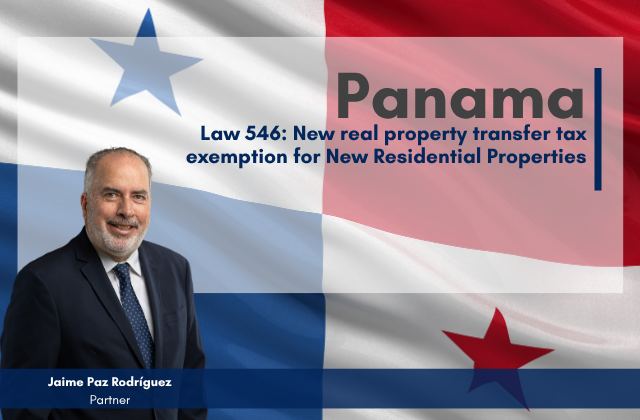
On August 31st, 2026, Law 546 was published in Official Gazette No. 30601-B, amending Article 4 of Law 106 of 1974, which governs the Real Property Transfer Tax (ITBI – for its acronym in Spanish). The Law took effect on the day following its enactment.
EXEMPTION UP TO US$ 120,000 REINSTATED
Law 546 reinstates the ITBI exemption on the first US$ 120,000 of the taxable base for the first sale of a new residential property, provided that the public deed is executed within two years following the issuance of the occupancy permit.
This benefit had ceased to apply as of January 1, 2026, following the expiration of the temporary regime that remained in effect through December 31, 2025. The taxpayer liable for the tax is the seller, and any contractual provision purporting to shift this obligation to the buyer is null and void as a matter of law.
WHAT’S NEW: PREFERENTIAL RATE SCHEDULE UP TO US$ 200,000
When the taxable base is between US$120,000 and US$ 200,000—a range that previously lost the exemption entirely once the first threshold was exceeded—the tax applies only to the amount exceeding US$ 120,000:
| Taxable Base of the Transfer | Rate on the Amount Exceeding US$120,000 |
| Over US$120,000 up to US$130,000 | 0.50% |
| Over US$130,000 up to US$150,000 | 1.00% |
| Over US$150,000 up to US$170,000 | 1.40% |
| Over US$170,000 up to US$190,000 | 1.60% |
| Over US$190,000 up to US$200,000 | 1.80% |
Moving into a higher bracket does not eliminate the exemption applicable to the first US$ 120,000: the applicable bracket rate is always applied only to the excess amount. For taxable bases exceeding US$ 200,000, the exemption remains in place, and the excess is taxed under the general 2% rate.
HOW IS THE TAX CALCULATED?
The tax is not calculated on the listing price, but rather on the taxable base established under Article 2 of Law 106: the greater of the price agreed upon in the public deed and the cadastral value of the property at the time it was acquired by the seller, plus the value of any improvements, plus 5% of both amounts for each full calendar year elapsed through the date of sale.
| New Apartment – US$165,000 | |
| Taxable Base | US$ 165,000 |
| Deducting Law 546’s exemption | US$ 120,000 |
| Taxable excess | US$ 45,000 |
| Applicable bracket rate | 1.40% |
| Payable Real Property Transfer Tax | US$ 630 |
*Under the previous regime: 2% of US$ 165,000, or US$ 3,300. The savings at closing amount to US$ 2,670.
INCOME TAX REMAINS UNCHANGED
Law 546 modifies only the Real Property Transfer Tax.
For taxpayers engaged in the sale of real property as part of their ordinary course of business, the first sale of a new residential property remains subject to the income tax established under Article 701(a) of the Tax Code, calculated on the greater of the total sale value or the cadastral value:
- 0.5% up to US$ 35,000
- 1.5% from US$ 35,000 to US$80,000, and
- 2.5% above US$80,000.
In the example above, this represents an additional US$ 4,125, which is unaffected by the reform.
HOW TO CLAIM THE EXEMPTION?
The seller must declare under oath in the public deed that the property is a new residential property, that this is its first sale, and that the closing occurs within the applicable period. The deed must also include the date and details of the occupancy permit.
A prior tax exclusion certificate from the Panama Tax Authority (DGI – for its acronym in Spanish) is no longer required. Instead, the exemption need only be reported through the mechanism established by the Tax Authority for registration and control purposes. Without the required statement in the public deed, the notary may not execute the deed, nor may the Public Registry register it.
A false statement will result in an obligation to pay the omitted tax, together with surcharges and interest, without prejudice to any applicable administrative, tax, civil, or criminal penalties.
TRANSITIONAL REGIME
Sales formalized after the Law takes effect may qualify for the benefit even if the occupancy permit was issued prior to the Law, provided that the closing occurs within thirty months following the issuance of the occupancy permit and all other requirements are met.
Sales already formalized are governed by the provisions in effect at the time the corresponding deed was executed and do not give rise to refunds.
WHY DOES IT MATTER?
Law 546 is not solely a tax measure. One of the purposes expressly identified by the Government is to reactivate residential construction, particularly in the segment of up to US$ 120,000, which was adversely affected after the previous temporary exemption expired on December 31st, 2025, and the Real Property Transfer Tax once again became applicable at the beginning of 2026.
The measure seeks to restore the viability of residential projects, encourage new developments, generate employment, and facilitate access to new housing.
In addition, Law 546 reduces the tax burden on the first sale of new residential properties valued at up to US$ 200,000 and prevents properties from losing the entire benefit merely because they exceed the US$ 120,000 threshold.
For developers and investors in residential projects in Panama, the new regime should be incorporated into pricing policies, closing schedules, and deed execution procedures, together with the shift from the Panama Tax Authority certificate requirement to a sworn declaration.
- US$120,000 home: from US$2,400 to zero.
- US$150,000 home: from US$3,000 to US$300.
- US$200,000 home: from US$4,000 to US$1,440.
- US$250,000 home: from US$5,000 to US$2,600, because the exemption on the taxable base remains in effect.
This article is provided for informational purposes only and does not constitute legal advice. For advice regarding your specific circumstances, we invite you to contact us directly at quijano@quijano.com.